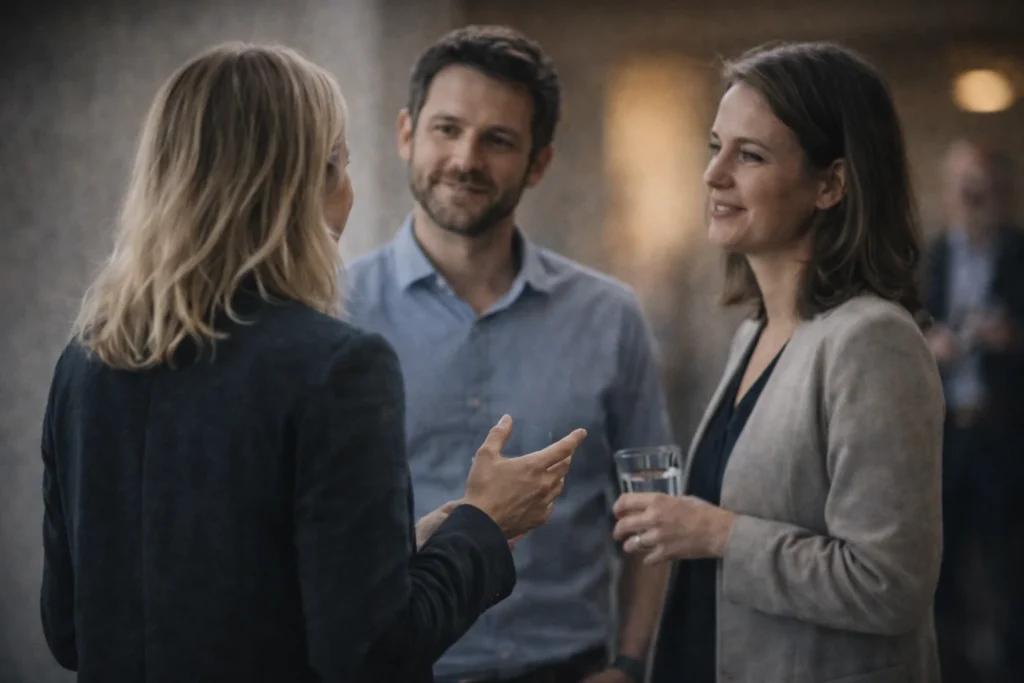


Why ‘soft skills’ are now survival skills
The term soft skills needs to be retired.
In today’s world, they’re not nice-to-haves. They’re survival skills.
Because as technology accelerates, one thing is becoming clear.
The people who succeed are not the ones who know the most – they’re the ones who connect the best.
The shift that’s already happened
For decades, professional success was driven by technical ability.
If you were smarter, more knowledgeable or more skilled than the person next to you, you had an edge.
That’s no longer true in the same way.
Today, AI can write reports instantly, generate ideas on demand and perform tasks that once signalled expertise.
But there’s one area where machines don’t outperform humans.
- They can’t build trust.
- They can’t read a room.
- They can’t sense hesitation.
- They can’t ask a thoughtful follow-up question at exactly the right moment.
- They can’t make someone feel understood.
AI can produce output. It can’t build relationships.
That’s where humans still have a clear edge. And that edge is becoming more valuable, not less.
The real competitive advantage
In this environment, success is increasingly determined by how people feel about you:
- Whether people feel comfortable working with you.
- Whether they think of you when opportunities arise.
- Whether they’re willing to introduce you to others.
In other words: relationships.
And relationships are built through behaviours often labelled as ‘soft skills’ – showing empathy, listening properly, taking initiative and building rapport over time.
These aren’t soft skills. They’re the skills that decide who gets hired, who gets promoted, who wins the business – and who gets remembered.
Why these skills are becoming rare
At the same time as these skills are becoming more important, they’re also becoming more scarce.
Not because people don’t understand them. But because they’re getting less practice.
Before the internet, most communication happened face-to-face or over the phone. You had no choice but to develop your interpersonal skills.
Now, a huge proportion of communication happens through email, Slack, text messages and project management tools.
These are efficient – but they remove friction.
And friction is where social skill is built.
As a result, many professionals avoid difficult conversations, hesitate to pick up the phone, feel uncomfortable approaching colleagues and overthink simple interactions.
It’s not that they lack knowledge. It’s that they’ve lost exposure. And over time, that creates something more powerful than a skill gap.
It creates hesitation.
The real barrier is social courage, not skill
Most people already know what they should do:
- Reach out to people.
- Follow up after meetings.
- Speak up in discussions.
- Build relationships proactively.
But they don’t. Not because they’re lazy. Not because they’re incapable. But because it feels uncomfortable.
They worry about saying the wrong thing, being judged, looking awkward or even being ignored.
So they wait – until they feel more confident, have a better reason or the timing feels right.
That waiting is what holds them back. Because confidence doesn’t come first. Action does.
This is the missing piece: social courage.
I didn’t arrive at this idea in theory. I arrived at it through repetition.
I’ve had lunch with 500 strangers. I’ve cold-called thousands of potential clients, with a rejection rate of around 98%. I’ve walked into networking events on my own and forced myself to start conversations.
Not because I enjoyed it. But because I wanted to get better.
What I learned was simple. The barrier was never skill. It was always the willingness to act before I felt ready.
These skills are learnable (even if you’re introverted)
A common objection at this point is: “I’m just not a people person.”
But that misunderstands how relationships are built. Social skills are not personality traits. They’re behaviours. And behaviours can be learned.
- Many extroverts feel just as nervous as introverts – they just hide it better
- Introverts are often better listeners, which makes them better conversationalists
- Confidence is not a prerequisite – it’s a byproduct of repetition
You don’t need to become someone else. You just need to start acting differently.
What this looks like in practice
You don’t need to take extreme action to improve your survival skills. You can start small:
- Walk over to a colleague instead of sending a message.
- Call a client instead of emailing.
- Follow up with someone you haven’t spoken to in a while.
- Attend an event and start one conversation.
These are not big moves. They’re small acts of social courage. And they compound quietly.
Over time, they lead to stronger relationships, greater visibility, more opportunities and increased confidence.
Not because you forced it – but because you showed up.
The rules of the game have changed
In the past, you could compensate for weak interpersonal skills by doubling down on technical ability.
Today, that approach is becoming a dead end.
You won’t out-think AI. And you won’t out-produce it either. But you can do things AI can’t:
- Build real relationships.
- Create trust over time.
- Bring people together.
- Communicate with clarity and nuance.
- Lead conversations, not just contribute to them.
Whether you’re a lawyer, engineer, banker or business owner – those are the skills that will set you apart.
Final thought
The most valuable skills in today’s world are no longer technical. They’re human.
And the people who develop them won’t just survive – they’ll stand out.
Because in a world where knowledge is abundant and automation is accelerating, connection becomes the ultimate advantage.
In the end, this all comes back to one thing: social courage.
Those aren’t soft skills. They’re survival skills.